

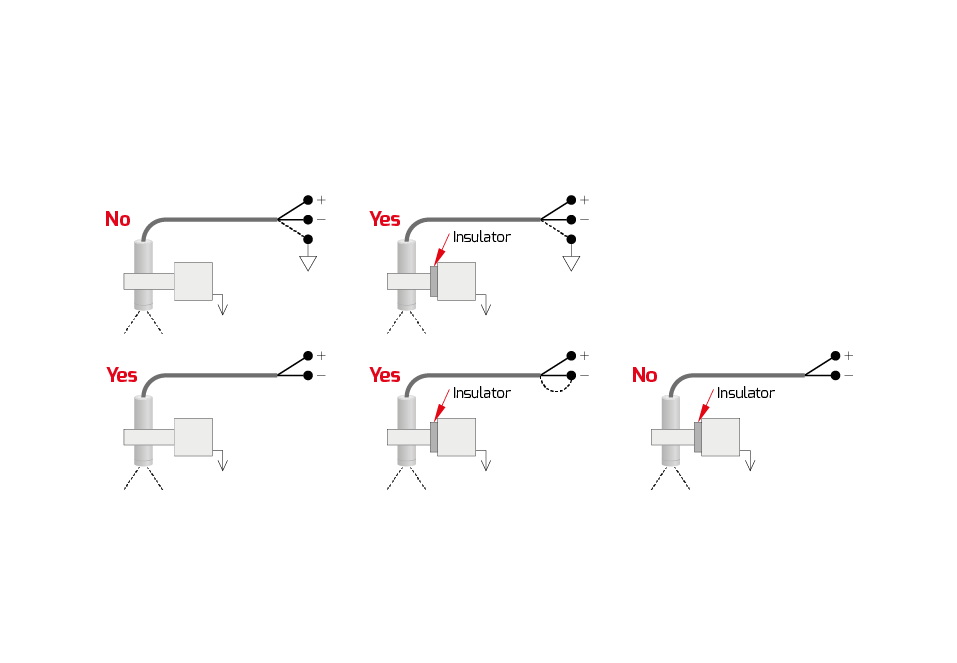


Applies to all models with
stainless steel housing
All IRt/c models with stainless steel housing are
built with complete electrical shielding of both the
housing and cable, with the measuring elements
electrically isolated from the housing (as in a con-
ventional ungrounded thermocouple). By adhering
to standard good practice in grounding and shielding
techniques, IRt/cs can provide outstanding perfor-
mance in the most severe electrical environments
commonly found in production processes.
When is attention to grounding
and shielding required?
Pay attention when the IRt/c operates in extreme
environments, or with long t/c cable runs. Be careful
when the measuring system utilizes the IRt/c’s high-
speed capability, or if the process can generate high
static electricity fields.
For most installations, the built-in noise rejection
characteristics of the IRt/c are sufficient to ensure
good performance, especially if the readout device
is heavily filtered with a long input time constant.
Can I operate ungrounded?
Yes, but it is not recommended, especially in appli-
cations where the process can generate high static
electricity fields. Examples are web processes of
all types, including printing, laminating, film drying,
etc. Without either the housing or shield grounded
to drain away the charge, a static charge can build
in the housing, which may eventually discharge
through the IRt/c sensing elements, and can cause
damage to the sensor.
How do I use the shield correctly?
The most important rule is to be sure the shield
is grounded at only one point, preferably at the
signal input ground. Keep in mind that the housing
is connected to the cable shield, and if the housing
is electrically in contact with machinery at the
mounting point, that point will be a ground, and
the shield wire should not be connected at the
instrument end. For best possible performance,
electrically isolate the IRt/c at the mounting point
and ground the shield at a suitable ground on the
readout instrument.
Can I ground the shield to the negative
(red) thermocouple lead instead of to a
chassis ground?
Yes, but test both alternatives in your application and
use the one that gives the cleanest signal. Be sure that
the housing is electrically isolated, otherwise ground
loop currents may cause errors.
Should the extension cable be shielded?
As indicated above, if the installation requires high
speed performance, twisted shielded extension cable
and connectors with ground straps should be used
throughout. Aluminum foil is a suitable material to
complete a shield if there are gaps in the shield
coverage.